v1g1lance.netlify.app
Generate Pgp Key Pair Ubuntu
- How To Generate Pgp Key Pair In Linux
- Pgp Key
- Generate Pgp Key Pair Ubuntu Download
- Linux Create Pgp Key Pair
- Pgp Key Generator
- Pgp Key Download
Apr 12, 2018 Step 1 — Create the RSA Key Pair. The first step is to create a key pair on the client machine (usually your computer): ssh-keygen By default ssh-keygen will create a 2048-bit RSA key pair, which is secure enough for most use cases (you may optionally pass in the -b 4096 flag to create a larger 4096-bit key).
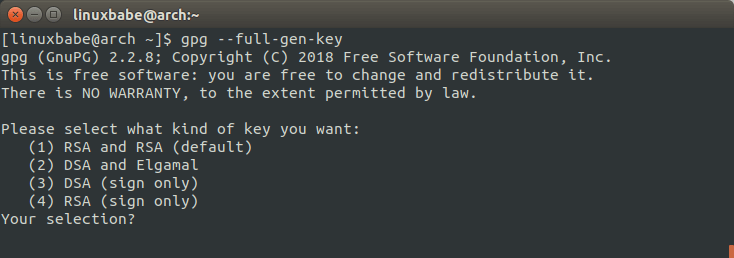
Now that GnuPG is installed, you’ll need to generate your own GPG key pair, consisting of a private and public key. The private key is your master key It allows you to decrypt/encrypt your files and create signatures which are signed with your private key. To generate a key pair with the PuTTY key generator, simply run puttygen.exe and click the Generate button in the window that appears. You will be asked to move the mouse and press keys to improve the random number generation at the heart of SSH security. Instead of using Amazon EC2 to create your key pair, you can create an RSA key pair using a third-party tool and then import the public key to Amazon EC2. For example, you can use ssh-keygen (a tool provided with the standard OpenSSH installation) to create a key pair. Generating a PGP Key Open the Passwords and Keys (Seahorse) application This screen will appear. Either go to File → New in the global menu or hit Ctrl + N. In the Create New. Window select PGP Key and hit Continue. Enter your full name and your email address, the comment is optional. Jul 01, 2019 Once GnuPG is installed, you’ll need to generate your own GPG key pair, consisting of a private and public key. The private key is your master key. It allows you to decrypt/encrypt your files and create signatures which are signed with your private key.
Introduction
Establishing an SSH (Secure Shell) connection is essential to log in and effectively manage a remote server. Encrypted keys are a set of access credentials used to establish a secure connection.
This guide will walk you how to generate SSH keys on Ubuntu 18.04. We will also cover setting up SSH key-based authentication to connect to a remote server without requiring a password.
- A server running Ubuntu 18.04
- A user account with sudo privileges
- Access to a terminal window / command line (Ctrl-Alt-T)
If you are already running an Ubuntu 18.04 server, you can skip this step. If you are configuring your server for the first time, you may not have SSH installed.
1. Start by installing the tasksel package:
The system will first ask for confirmation before proceeding:
2. Next, use tasksel to install the ssh-server:
3. Load the SSH server service, and set it to launch at boot:
On your client system – the one you’re using to connect to the server – you need to create a pair of key codes.
To generate a pair of SSH key codes, enter the commands:
This will create a hidden directory to store your SSH keys, and modify the permissions for that directory. The ssh-keygen command creates a 2048-bit RSA key pair.
For extra security, use RSA4096:
If you’ve already generated a key pair, this will prompt to overwrite them, and those old keys will not work anymore.
The system will ask you to create a passphrase as an added layer of security. Input a memorable passphrase, and press Enter.
This process creates two keys. One is a public key, which you can hand out to anyone – in this case, you’ll save it to the server. The other one is a private key, which you will need to keep secure. The secure private key ensures that you are the only person who can encrypt the data that is decrypted by the public key.
Step 2- Copy Public Key to the Ubuntu Server
First, get the IP address of the Ubuntu server you want to connect to.
In a terminal window, enter:
The system’s IP address is listed in the second entry:
On the client system, use the ssh-copy-id command to copy the identity information to the Ubuntu server:
Replace server_IP with the actual IP address of your server.
If this is the first time you’re connecting to the server, you may see a message that the authenticity of the host cannot be established:
Type yes and press Enter.
The system will check your client system for the id_rsa.pub key that was previously generated. Then it will prompt you to enter the password for the server user account. Type it in (the system won’t display the password), and press Enter.
The system will copy the contents of the ~/.ssh/id_rsa.pub from the client system into the ~/.ssh/authorized_keys directory of the server system.
The system should display:
If your system does not have the ssh-copy-id command, you can copy the key manually over the SSH.
Use the following command:
To log in to a remote server, input the command:
The system should not ask for a password as it is negotiating a secure connection using the SSH keys. If you used a security passphrase, you would be prompted to enter it. After you do so, you are logged in.
If this is the first time you’ve logged into the server, you may see a message similar to the one in part two. It will ask if you are sure you want to connect – type yes and press Enter.
Step 4- Disable Password Authentication
This step creates an added layer of security. If you’re the only person logging into the server, you can disable the password. The server will only accept a login with your private key to match the stored public key.
Edit the sshd_config file:
How To Generate Pgp Key Pair In Linux
Search the file and find the PasswordAuthentication option.
Edit the file and change the value to no:
Pgp Key
Save the file and exit, then restart the SSH service:
Verify that SSH is still working, before ending the session:
If everything works, you can close out and resume work normally.
By following the instructions in this tutorial, you have setup SSH-key-based authentication on an Ubuntu 18.04 server.
The connection is now highly secure as it uses a set of unique, encrypted SSH keys.
Next you should also read
Learn how to set up SSH key authentication on CentOS to safely communicate with remote servers. Create the…
When establishing a remote connection between a client and a server, a primary concern is ensuring a secure…
Nginx is an open-source server utility designed to work as a reverse proxy, intercepting client requests and…
In this tutorial, Find out How To Use SSH to Connect to a Remote Server in Linux or Windows. Get started with…
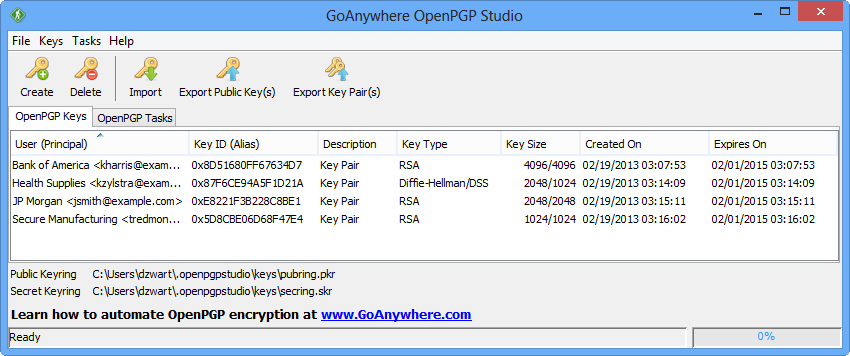
There are four steps for generating a keypair. We assume, that Alice wants to generate a keypair, so she can decrypt texts, which are encrypted for her.
STEP 1: Open keymanagement
First Alice opens the keymanagement through the toolbar.
Generate Pgp Key Pair Ubuntu Download
STEP 2: Open generate key dialog
Secondly she opens the generate key dialog through the 'key'-menu
Adding your SSH key to the ssh-agent. Before adding a new SSH key to the ssh-agent to manage your keys, you should have checked for existing SSH keys and generated a new SSH key. When adding your SSH key to the agent, use the default macOS ssh-add command, and not an application installed by macports, homebrew, or some other external source. Generating Your SSH Public Key. Many Git servers authenticate using SSH public keys. In order to provide a public key, each user in your system must generate one if they don’t already have one. This process is similar across all operating systems. First, you should check to make sure you don’t already have a key. Git ssh key generate command.
STEP 3: Fill in the form
Now she fills in the forms.
NOTE: A key with a higher bitrate is more secure, but also needs a more time to encrypt and decrypt texts. To generate a key, you only have to provide a name. Even the passphrase could be empty (which of course lags of security).
Linux Create Pgp Key Pair
Pgp Key Generator
STEP 4: Wait while key is generated
Pgp Key Download
Now Alice has just to wait. The process of the key generation is faster, when Alice does something on her PC, so that the randomdevice gets more input and so more entropy.
When the generation dialog box disappears, the key generation is finished.