v1g1lance.netlify.app
Keepass 2 Generate Key File
Unfortunately, not every website on the internet takes security all that seriously and still requires users to sign-up and authenticate with usernames and passwords. More progressive websites have started to allow users to log-in with their existing passwords but tack on a “second factor” authentication such as an SMS/text message code being sent to your phone or an e-mail with a One-Time Password (OTP).
Click Generate to generate your secret key. You will need this key to program your KeePass database and to recover it if something goes wrong. Copy this key and keep it in a secure location. Click Write Configuration. A message stating that your YubiKey has been successfully configured is displayed in the Results pane. Jan 20, 2020 KeePass can generate strong passwords for you too if you think yours are too weak. KeePass supports two encryption modes: AES 128-bit with 256-bit key and Twofist 128-bit with 256-bit key. Both are pretty strong and can’t be decoded easily. Tons of plugins and extensions are available for KeePass that enhance its functionality even more. It is recommended that you use LibreOffice Calc to create a correct CSV file (see below), or use the Generic CSV Importer of KeePass 2.x (import your CSV file into KeePass 2.x, then export the data to a KeePass 1.x KDB file), or fix the CSV file by manually adding the quotes using a text editor. A key file can be used instead of a password, or in addition to a password (and the Windows user account in KeePass 2.x). A key file can be any file you choose; although you should choose one with lots of random data. How is a new key pair generated for the server download. A key file must not be modified, this will stop you opening the database. Jul 28, 2019 KeePass is another way to go about this; by using KeePass and the KeeAgent plugin, we can use the KeePass database as a container for our keys and have it serve when needed. This has the advantage that the SSH keys are synced with the KeePass database. Install things KeePass. Ensure KeePass2 Professional Edition is installed. To generate a key file, KeePass uses a cryptographically strong random number generator with some additional entropy. KeePass supports three key file formats: 1) XML file with 32-byte key encoded as Base64 string (those 45 characters you mentioned) 2) Text file with a 32-byte key encoded as a hex string.

Inversely, Password Managers solve the problem of having to remember thousands of passwords to different websites but the security of these managers are typically sub-par and often require a single password (“master password”) to access your list of passwords. Talk about putting all of your eggs in one (very insecure) basket.
How To Secure Your Passwords
Public Key Infrastructure (PKI) digital certificates are the answer. The idea is that you will generate a secure (and lengthy) private key and use that key to encrypt another key and use that final key as your “password” to unlock your password manager. Vidbox video conversion for mac product key generator. On top of that security, you should also be able to provide a password that you know to go with it.
I will show you how to protect your KeePass password manager with true Two-Factor Authentication (2FA) using something you have and something you know.
Getting Started
Download KeePass (if you’re not already using it)
Keepass 2 Generate Key File With The Keygen Fl Studio
Download the KeePass CertKeyProvider plugin
Once you have downloaded the plugin, copy the PLGX file into your KeePass software directory (where your KeePass.exe is located).
Generate a PKI certificate
If you don’t already have a certificate to use you can generate one using OpenSSL. I outline the steps of creating a new certificate in another article; Securing OpenSSH with WWPass PassKey in Step #1. If you already have a digital certificate (preferably loaded on a Smartcard) then you can skip this step.
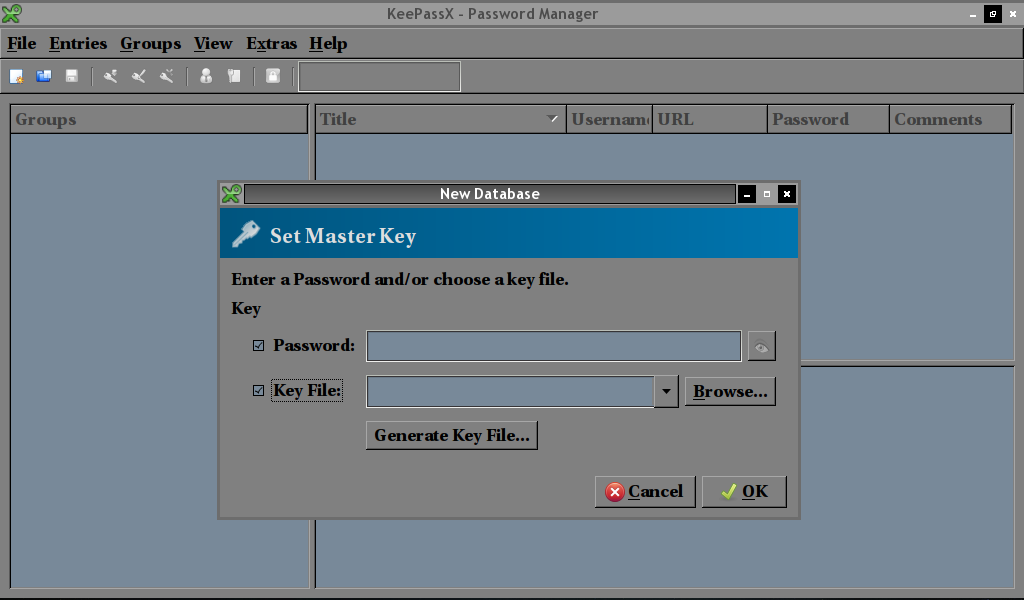
Configure KeePass Security
- Launch KeePass to get started. Create a new database (File->New) and tell KeePass where to place this new database.
- You should now see the Create Composite Master Key page. Here you should specify a Master Password and change the Key file / provider to Certificate-protected key.
- Choose a place to save your encrypted key file (which can only be “unlocked” using your password and certificate).
- Select a certificate to use to protect your key file.
Conclusion
Generate Key Code
You’ve now set up a KeePass database that can only be opened if you provide a correct password and also a digital certificate. Quick and dirty Two-Factor Authentication for your list of passwords. If you need more security you should consider storing your certificates within a secure platform such as a Smartcard or the WWPass PassKey. These allow you to create a private key or import an existing one but from then on your private key will never leave the device again. This is considered an “unextractable” key and is a considerable increase in security as your private key can no longer be stolen through software (viruses, malware, etc…) or physical theft.